Building and Scaling a People Analytics Function

Getting Started with People Analytics
People analytics is becoming increasingly important in today’s business landscape. As cost of labor continues to increase and compensation is the biggest cost, there is a heightened focus on using analytics to inform HR decisions to optimize compensation, drive employee engagement, and retain high-performing talent, amongst other areas across the employee lifecycle. However, many companies still need help with getting started with people analytics due to a lack of knowledge or an inadequate understanding of how data can be leveraged effectively to maximize value for their HR departments. In this post, we’ll explore the basics of getting up and running with people analytics, covering topics such as:
- Understanding the most critical HR and business challenges
- Hiring the right talent for your people analytics team
- Building your People Data Infrastructure
- Identifying and prioritizing key people metrics to focus on
- Automating ongoing reporting to focus on more strategic initiatives
- Scaling a people analytics function over time
What is People Analytics?
People analytics is about using data to understand people’s behavior, motivation, impact, and outcomes. These insights empower not only HR but leaders and managers across the company to make informed decisions about organizing, prioritizing, communicating, and collaborating within their own organization. By using people analytics, businesses gain valuable insights that help them optimize recruitment processes, drive higher employee performance and engagement, and identify and implement retention strategies to create a high-performing environment and lower costs across the company. As the work environment rapidly changes, people analytics is quickly becoming a secret weapon used by organizations worldwide to maximize people’s potential and increase overall organizational efficiency.
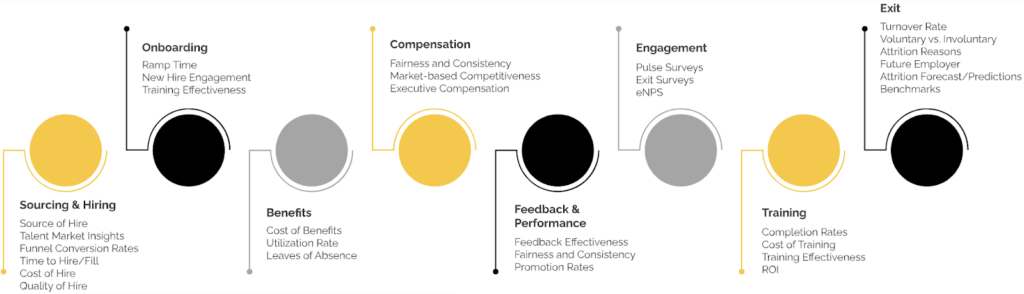
People Analytics spans the employee lifecycle – ranging from sourcing candidates to exit.
Why is People Analytics important?
As the workplace evolves with advanced technologies, challenges like shrinking margins and advancing competencies require companies to manage their people proactively. By understanding things like employee engagement, job performance insights, internal communications strategies, and external talent market trends, people analytics provides organizational leaders visibility into potential success or exposure areas that could otherwise remain hidden. With this knowledge, today’s smart organizations can make informed decisions about their greatest asset – employees – leading to an overall higher return on investment for the entire organization. Below are a few of the outcomes that using people analytics can influence.
- Drives and informs hiring strategies through assessing the talent funnel to understand what drives success and bottlenecks.
- Helps identify why high performing employees may be leaving, where they are going, and what you can do to lower future attrition.
- Improves Diversity & Inclusion (D&I) through ensuring that you are not only bringing in diverse talent but also developing, engaging, and retaining them.
- Ensures Fairness and Consistency through informed decisions using data such as conducting pay equity analysis and consistently evaluating fairness and equity across people programs.
- Improves Employee Engagement by allowing you to have a pulse on employee sentiment through ongoing surveys and other employee listening programs.
- Increase Productivity through better insights on where employees are currently spending their time.
- Creates a culture of Learning & Development through visibility into ongoing insights and actions on career development and feedback.
- Enables Better Workforce Planning through better forecasting and planning for what talent you are expected to lose and you need to hire against your future company roadmap.
Steps to Get Started
While there is no single linear process in starting people analytics that is suitable for every organization due to variation in organization maturity and business needs, the steps below are meant to illustrate areas that could be applicable across most organizations. By following the steps highlighted below thoughtfully and continuously evolving along the way based on feedback and results, organizations can begin to capture the truly transformative power that people analytics can offer.
1. Understand the Most Critical HR and Business Challenges
People analytics is increasingly important in dealing with critical HR and business challenges and applying people analytics starts with understanding what problem you are trying to solve for. Different problems require a different approach. For example, trying to understand why you are losing high performing talent vs. how to ramp up your new sales representatives faster may require completely different approaches to what data you collect, how you collect it, and types of analysis to conduct. Start by understanding exactly what outcomes you are trying to inform with people data, where there are biggest people data gaps within your organization, and how your data will help influence people decisions.
Practical tip: Start by having conversations with your top business leaders to assess the biggest challenge they are facing as it relates to people. Based on input from business leaders, narrow down top people priorities and challenges, then identify what data can be used to measure and improve against each priority/challenge.
2. Hire a People Analytics Lead
Building a dedicated people analytics team within an organization may vary depending on the readiness and maturity of the organization. However, bringing in a dedicated people analytics lead early into building out the function can positively influence how you structure the team, processes, and quality of people data that is captured and stored for future analysis. This individual should have the appropriate technical skills and business acumen to develop strategies designed to improve people-related processes across the organization and should help bridge the gap between assessing business needs and applying analytics to drive impact across the organization.
The people analytics lead should have the experience and knowledge to help companies identify meaningful trends, create actionable insights, and equip leaders with the information needed to make informed decisions related to their people. With an experienced people analytics lead on board, you can confidently move forward, knowing that your investments in a people analytics function are informed by an expert.
Practical tip: Focus on bringing in individuals with a more holistic skill set within people analytics, including HR knowledge, foundational understanding of BI, statistical analysis, business acumen and storytelling skills. As you scale out the people analytics team, focus on bringing more specialized skill sets (i.e. individuals with I/O backgrounds and data scientists) to provide deeper insights into people decisions.
3. Build your Data Infrastructure
The important aspect of having a trustable and efficient people analytics function is having the right data infrastructure in place. This starts with ensuring that you have the appropriate tools to collect, transform, and analyze data in an automated manner. Organizations that fail to invest early in the appropriate data infrastructure and tooling tend to lack the ability to truly scale their people analytics function and typically get stuck in the cycle of spending their efforts on manually reproducing reports using local data sources (i.e. Excel/Google sheet) and are unable to evolve and provide meaningful insights to the business.
Building the right data infrastructure starts with having a secure data warehouse dedicated to people data with automated data feeds from key HR systems (HRIS, ATS, LMS, etc.) and appropriate BI tools to automatically visualize key people metrics. Consider exploring what existing capabilities,resources, and tools you have with your organization to help assess whether to build an internal data warehouse or leverage an external solution. Ultimately, having a well-structured data infrastructure is key when beginning any people analytics initiative so that you can analyze and interpret data efficiently.
Practical tip: A solution such as One Model can significantly help accelerate the progress against having the appropriate data infrastructure up and running quickly. Alternatively, consider hiring an internal BI engineer dedicated to People data to help building out this infrastructure.
4. Identifying and prioritize people metrics to focus on
Across the employee lifecycle, there are hundreds of people metrics ranging from time-to-hire, performance ratings, engagement scores, attrition rates and many more. While it may be tempting to start building reporting and dashboards that provide insights across the employee lifecycle, it’s important to revisit what business problem you are trying to solve and how the specific metrics you are focused on will help make informed decisions. Integrating HRBPs and key HR program decision-makers will help provide clarity into what metrics to focus on.
Practical tip: Build clear objectives of the most pressing areas of people you need visibility into. Then, consider building a data dictionary/catalogs of the categories and specific metrics that are important and prioritize which ones to focus on first.
5. Automate Ongoing Reporting
Automating ongoing reporting is key to ensure that your people analytics practitioner(s) are spending their valuable time on providing strategic insights and action for the business as opposed to replicating repetitive reports. The right technology can help streamline ongoing reporting and deliver time-sensitive, accurate insights so businesses can make decisions quickly. Automating ongoing reporting saves time and resources, reduces the risk of errors, and ensures that all stakeholders have access to reliable data that is up to date.
By developing the right people analytics dashboards that allow you to automate collecting and analyzing data, you can eliminate hours of cumbersome manual work and use that time to start making data-driven decisions. This helps ensure that people analytics becomes an embedded part of your organization’s workflow and produces consistent value over the long term. Automated dashboards enable people analytics practitioners to anticipate the needs of their organization better, freeing up time for valuable decision-making.
Practical tip: Start with evaluating which reports/deliverables you are spending the most time reproducing on a recurring basis and focus on automating those first. Solutions such as One Model and Visier help easily build these dashboards but you may opt to use an internal BI tool to custom build these reports and dashboards.
6. Scale the People Analytics Function
Once an organization has established a strong people data foundation and removed time-consuming tasks such as recurring reporting through automation, you’re able to increase the maturity of your people analytics function and answer more complex questions such as:
- What are the key drivers of attrition for high-performers within your organization?
- Is there a pay gap between men and women doing similar work?
- What drives engagement within your organization?
As you pivot to more complex analysis, it becomes increasingly important to have the right talent so you can confidently answer these questions and make decisions based on statistical insights. At this stage in the journey, organizations typically consider hiring more specialized talent such as an I/O psychologist or a data scientist who brings in appropriate expertise with leveraging data to draw statistically sound conclusions.
Practical tip: Assess the level of maturity your organization is at with leveraging people analytics. The complexity of the questions will inform your decision on what types of talent to invest in for the People analytics team. Understand how the skillset of the new team members will be utilized and ensure they have the growth mindset and opportunities as you scale your people analytics function.
In summary, the work environment is rapidly evolving as organizations explore new ways ranging from pivoting to a 4-day work week to evaluating how to leverage AI technologies such as ChatGPT and finding the suitable location strategy (i.e. remote vs hybrid) to attract, develop, and retain talent. The need for leveraging data to inform these decisions is greater than ever before and organizations today are quickly grasping the value and ROI of investing in People Analytics early across all industries.